A concept in Paris
Suzuki unveiled its S-Cross concept at the Paris Motor Show, signalling an entry into the larger C-segment crossover market. Source ↗
 MUSEUM
Model evolution
From the 2012 Paris concept to a worldwide crossover with ALLGRIP and hybrid power. The original SX4 family evolved—and so did the name.
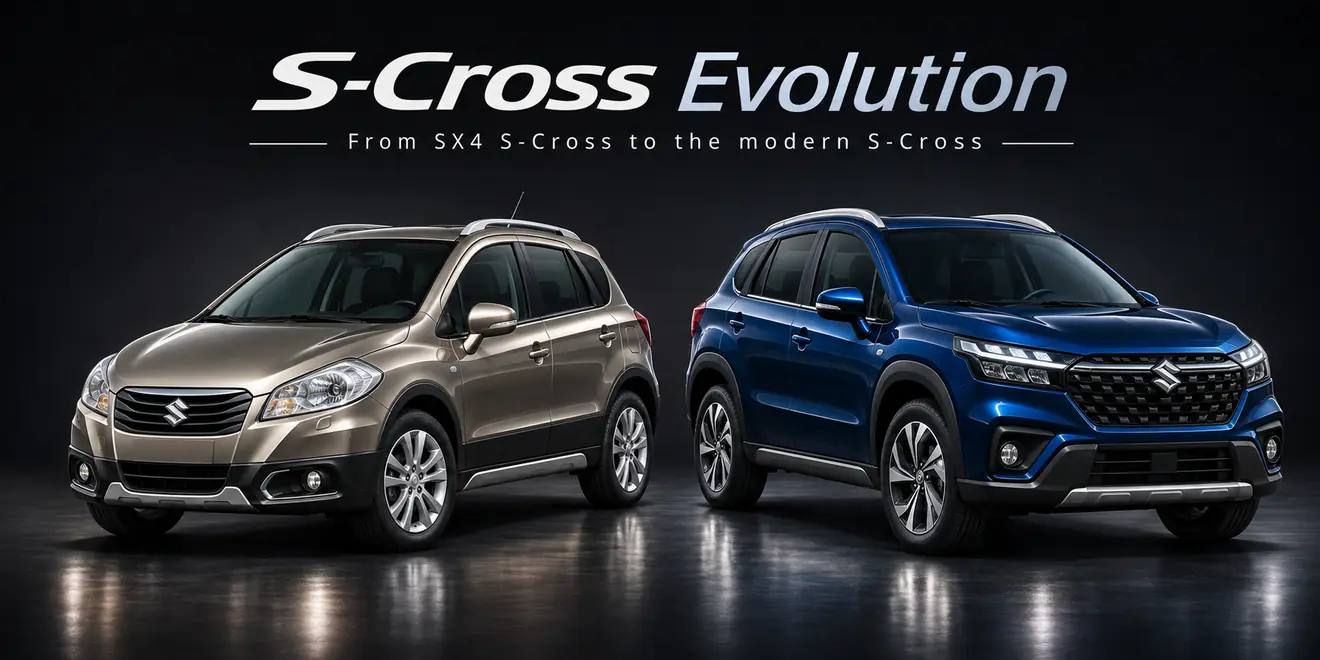
The S-Cross story began as a larger successor to the original 2006 SX4. Suzuki used SX4 S-Cross for the 2013-era model, while the late-2021 redesign was promoted simply as S-Cross. This exhibit follows those identity and design changes without suggesting that every redesign required a completely new platform.

A longer, more spacious crossover than the first SX4, with a new C-segment mission.
Photograph: Robert Basic · CC BY-SA 2.0 · locally optimized
The updated front fascia, revised lighting and turbo-petrol engines helped redefine the model.
Photograph: Motorkleding · CC BY-SA 4.0 · locally optimized
SUV-style proportions, a stronger grille treatment, new safety technology and hybridised power.
Photograph: ROCostiTheBunnyCZ · CC BY-SA 4.0 · locally optimizedAll three are actual period photographs, not AI reconstructions. The dates on the cards refer to the design era; individual photographs may have been taken in later years.
Eight documented milestones trace the concept, production programme, regional expansion and electrified versions.
Suzuki unveiled its S-Cross concept at the Paris Motor Show, signalling an entry into the larger C-segment crossover market. Source ↗
The production model premiered in Geneva in March; Magyar Suzuki in Hungary began building it later that year. Source ↗
Hungarian-made SX4 S-Cross launched in Japan; Maruti Suzuki introduced an Indian-built S-Cross with two DDiS diesel options. Source ↗
A grille, lighting and ride-height update gave the model a stronger SUV character; European petrol options added 1.0 and 1.4 BOOSTERJET turbos. Source ↗
Suzuki's 48V SHVS system arrived for the European SX4 S-Cross as the range moved toward hybridised petrol engines. Source ↗
Unveiled in November with a taller-looking front, a new cabin presentation, enhanced safety features and 1.4 mild-hybrid power. Source ↗
Suzuki expanded S-Cross hybrid choice in Europe with a 1.5-litre strong hybrid alongside the 1.4 mild hybrid. Source ↗
Suzuki UK's published October 2026 range lists Motion and Ultra mild hybrids, plus a Kuro appearance edition. Source ↗
The S-Cross carried Suzuki’s ALLGRIP SELECT all-wheel-drive system on selected models. A rotary control allowed the driver to choose a response suited to the surface. The four modes differ from the earlier first-generation SX4's 2WD / Auto / Lock controls.
Emphasises efficiency; can direct more torque rearward when needed.
Sharpens driving response and front/rear torque management for lively road driving.
Prioritises traction and stability on lower-grip surfaces.
Helps traction in difficult low-speed conditions; intended for escape from slippery terrain.
ALLGRIP is not fitted to every S-Cross. The available modes and operating details depend on market and model year. Historical overview: Suzuki's 2016 ALLGRIP announcement.
A single S-Cross badge covered very different drivetrains over time. European 1.6 diesels and India’s DDiS 200/320 arrived in different programmes; today’s European range is primarily hybrid petrol.
| Market / era | Engine family | Transmission and drivetrain notes | Context |
|---|---|---|---|
| 2013 Europe | 1.6 L petrol / 1.6 L DDiS diesel | Manual / CVT petrol / diesel transmission by version; FWD or ALLGRIP variants | 2013 launch specification |
| 2015 India | DDiS 200 1.3 L / DDiS 320 1.6 L | 5-speed and 6-speed manual respectively; Indian NEXA launch | Maruti Suzuki debut |
| 2016 facelift Europe | 1.0 L / 1.4 L BOOSTERJET petrol | Turbocharged petrol choices replaced the 1.6 petrol; diesel persisted in selected markets | 2016 facelift |
| 2020 Europe | 1.4 L BOOSTERJET + 48V SHVS | Mild-hybrid petrol option with integrated starter-generator | Electrified first design era |
| Late 2021 Europe | 1.4 L turbo petrol + 48V SHVS | Standard mild hybrid at European redesign launch; ALLGRIP optional | Redesigned S-Cross |
| 2022 Europe | 1.5 L DUALJET strong hybrid | Motor-generator and automated manual-type AGS transmission; selected 2WD/AWD markets | Strong-hybrid range |
| 2026 UK | 1.4 BOOSTERJET mild hybrid | Motion / Ultra and Kuro appearance trim; manual/automatic and selected ALLGRIP | Official UK range |
Not every engine, gearbox or AWD combination was sold in every market. Confirm against an individual year's brochure before using these as fitment or parts specifications. Sources: 2013 Suzuki release, Indian launch, 2016 BOOSTERJET announcement, 2021 redesign.
Suzuki offered two distinct levels of electrification. The 48V mild hybrid assists the petrol engine; the 1.5-litre strong hybrid uses a higher-voltage motor-generator package and can move briefly under electric power. Their equipment and availability have changed by country and year.

A photographed 1.5-litre S-Cross strong-hybrid example, showing the newer body's proportions.
Photograph: Charles · CC BY 2.0 · locally optimized
A period interior photograph illustrating the newer central display and cockpit arrangement.
Photograph: AutoMotoVlog · CC BY 3.0 · locally optimizedSHVS 48V mild hybrid is not interchangeable with Suzuki's 1.5 strong-hybrid system. The engine, battery, motor and transmission architecture differ.
Suzuki's official S-Cross technical overview ↗A UK Motion, an Indian NEXA diesel and a Japanese import do not share a universal equipment specification. The museum tracks the manufacturer, model year and country to keep the historical record accurate.
Magyar Suzuki in Esztergom built and exported the SX4 S-Cross from 2013, with petrol, diesel, AWD and later hybrid offerings.
Original manufacturer source ↗Suzuki introduced the Hungarian-built SX4 S-Cross in Japan in February 2015, including an ALLGRIP-equipped 4WD variant.
Original manufacturer source ↗Maruti Suzuki launched the locally produced S-Cross in August 2015 with DDiS 200 and DDiS 320 diesel engines; later Indian powertrain and grade names differed from Europe.
Original manufacturer source ↗The October 2026 Suzuki UK catalogue identifies Motion and Ultra mild-hybrid grades, with a Kuro styling edition and selected ALLGRIP combinations.
Original manufacturer source ↗The original 2006 SX4 hatchback, North American SportBack, sedan, diesel variants and Fiat Sedici are documented separately.
Browse the worldwide SX4 variant register ↗Factory announcements anchor key dates and specifications; original photographed vehicles show the design changes. The photographs are optimized and hosted by this museum, with the named authors and reuse licences preserved beneath each image.
SX4 Museum is an independent enthusiast archive, not an official Suzuki website. Manufacturer specifications, features, model nomenclature and availability depend on country and year. All photos identify their authors and reuse licences; original source links are provided.